Dyslexia Signs in Children Ages 4 to 8
Letter reversals and vision problems aren't the real signs; listen for trouble with sounds instead.
Start with what it isn't, because the myths run deep and they cost families time.
Dyslexia is a difference in phonological processing: how the brain maps spoken sounds to written symbols. Vision, intelligence, and effort aren't the mechanism at work, and that mapping is harder to build for a dyslexic brain. No amount of squinting at the page or trying harder fixes it.
Here's a myth worth killing outright: letter reversals. Writing "b" for "d" gets treated as the calling card of dyslexia in a lot of parenting forums and even some classrooms. But flipping letters is a completely standard hurdle for many typically developing kids, especially before age 7. Treating it as the defining symptom means missed diagnoses and delayed ones, because parents and teachers are watching for the wrong signal. The actual early indicators live in auditory and language processing: how a child hears sounds, plays with rhythm, and manipulates spoken words.
Then there's the boys-only myth. Older research reported dyslexia far more often in boys, and that shaped decades of screening habits. Current work from the Child Mind Institute suggests it affects boys and girls at close to equal rates. That said, a 2022 meta-analysis in Brain Sciences found a higher pooled prevalence in boys (9.22%) compared to girls (4.66%). The debate is genuinely alive in the research, which is worth naming honestly instead of picking a side to sound tidy. What matters practically is that girls get missed or diagnosed later more often, so parents of daughters shouldn't assume the condition mostly skips them.
So what actually separates a red flag from a normal hiccup? It comes down to severity and persistence. Nearly every young child mispronounces words or mixes up letters at some point. The question is how long that lasts and how intense the pattern gets, relative to peers and relative to age-typical timelines.
One more piece of context worth holding onto: dyslexia rarely travels alone. About 35% of kids with dyslexia also have ADHD, and around 20% have an anxiety disorder. That overlap complicates the picture parents are trying to read, since attention struggles or emotional avoidance can mask, or get mistaken for, the underlying language processing difference.
Signs to watch for at ages 4–5, before formal reading begins
Here's something that surprises a lot of parents: dyslexia shows up before a child ever opens a book, because it affects the language skills reading is built on. A 4-year-old isn't decoding anything yet, but the raw materials for decoding, sound awareness, rhythm, and vocabulary, are already forming, and you can watch them form unevenly.
The British Dyslexia Association and Scottish Rite for Children point to a consistent set of preschool warning signs:
- Trouble learning nursery rhymes or keeping a simple beat
- Difficulty recognizing rhyming patterns, or producing a new rhyme on request
- Muddled pronunciation well past the age when it's typical: "cubumber" for cucumber, "flutterby" for butterfly
- Speech or vocabulary that sounds younger than the child's actual age, including lingering baby-talk patterns
- A history of slow or late speech development
- Trouble learning and holding onto letter names, days of the week, or the order of a familiar song
- Difficulty sitting through or following a read-aloud story
Family history matters more than most parents realize here. About 40% of siblings of a child with dyslexia also have it, and up to 60% of kids with dyslexia have at least one parent who struggled with reading too. If you had a hard time learning to read, that's not a footnote. It's a reason to watch your own child's early language development more closely, not less.
None of these signs, on its own, means anything definitive. A kid who mispronounces "cucumber" at 4 is probably just being 4. What matters is the pattern: several of these signs together, persisting past the age when most kids grow out of them.
Signs that emerge at ages 5–6, as kindergarten introduces formal reading
Kindergarten changes the game, since this is the first year reading instruction gets explicit and the demands on decoding sharpen fast. The signs shift too, moving from purely spoken language struggles to print-specific ones.
Watch for:
- Trouble learning the alphabet, or forgetting letter order even after repeated practice
- Difficulty connecting sounds to the letters that represent them (this is called sound-symbol correspondence, and it's the foundational phonics skill)
- Struggling to identify or generate rhymes even after classroom drilling
- Trouble counting syllables in spoken words
- Slow, effortful attempts at sounding out simple words like "cat" or "dog," when classmates are starting to decode those automatically
All of this points back to one thing: phonological awareness, the ability to hear, isolate, and play with individual sounds inside words. It's one of the strongest predictors of reading success researchers have identified, and weakness in it tracks closely with dyslexia risk. Kindergarten signs are, in a real sense, phonological awareness signs wearing a different outfit.
There's a second marker worth knowing about: rapid automatized naming, or RAN. It's the speed at which a child can name a string of familiar things, letters, numbers, colors, in sequence. Slowness here shows up at this age too, and NIH research links RAN deficits to later reading difficulty.
One framing note, because it matters: a kindergartner who struggles with phonics may be showing an early sign worth documenting, rather than simply lagging behind on a timeline. That struggle is information worth bringing to a teacher, not waiting out.
Signs that persist or intensify at ages 7–8, in first and second grade
By first and second grade, reading stops being introductory. Kids are expected to decode on their own, build fluency, and start reading to learn rather than learning to read. A child with dyslexia is now being measured against demands that keep climbing, and the gap tends to widen if it hasn't been addressed.
What that looks like:
- Persistent trouble sounding out unfamiliar words, even after phonics instruction; still guessing from context or the first letter instead of actually decoding
- Slow, effortful reading that isn't closing the gap with peers over time
- Spelling that's inconsistent and phonetically implausible, meaning it's not just wrong, it shows no stable link between sound and letter at all
- Avoiding reading tasks, or complaining of headaches and tiredness specifically during reading
- Trouble following multi-step spoken directions, which points to working memory strain that reaches beyond reading itself
- Signs bleeding into math: trouble reading number words, struggling with word problems, early numeracy issues (dyslexia and dyscalculia co-occur at a meaningful rate, which muddies both identification and support)
The Learning Disabilities Resources Foundation of America flags age 8 as a point where red flags need immediate attention. What looked like ordinary developmental variation at 5 or 6 has, by now, hardened into a pattern that won't resolve by itself.
That gap shows up at scale too. The 2024 National Assessment of Educational Progress found only about one in three students nationally reads at grade level, and unidentified reading difficulties, including dyslexia, are a significant factor in that number. That reflects what happens when a processing difference goes unaddressed through the exact years intervention works best.
Why phonological awareness is the thread running through every stage
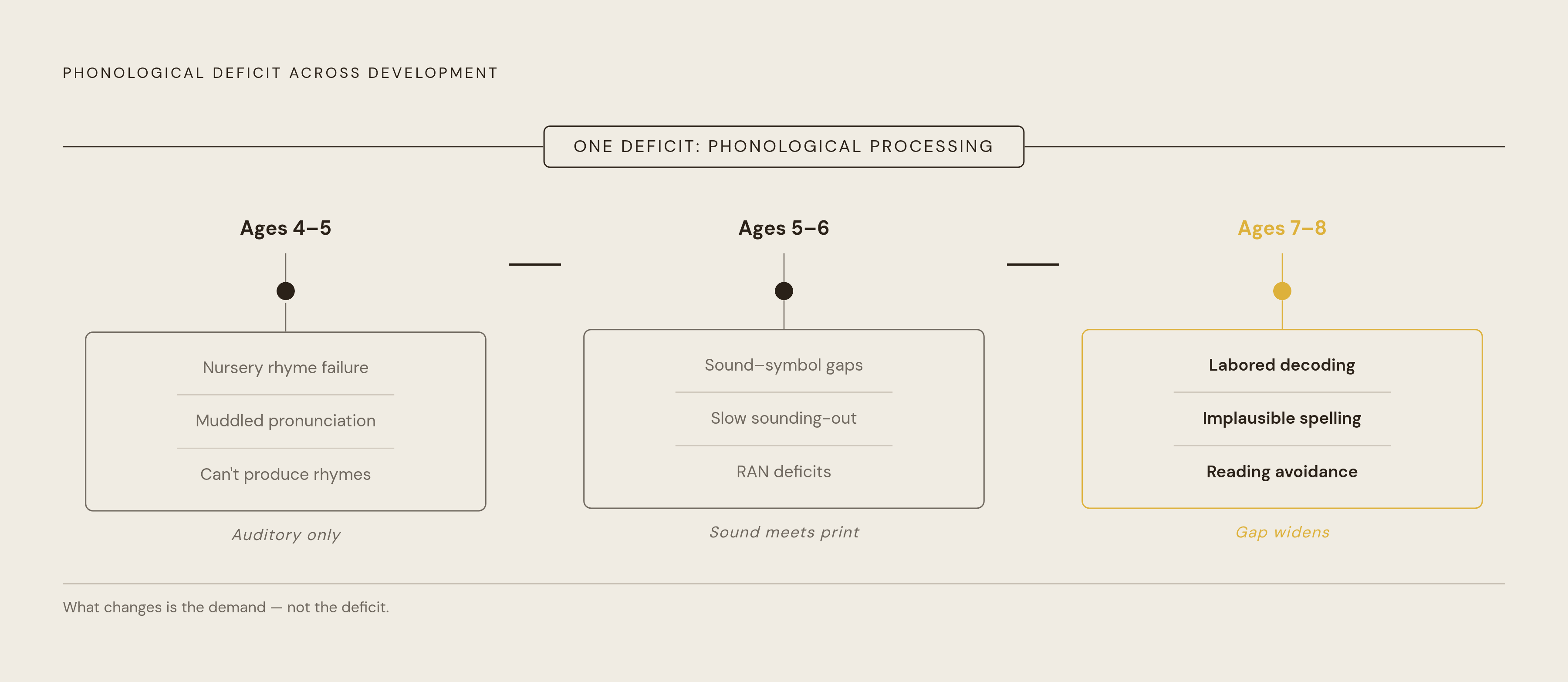
Step back and look at everything covered so far: rhyming trouble at 4, sound-symbol confusion at 5, labored decoding at 8. All of it traces back to sound: how a child hears, segments, and manipulates the spoken structure of language, rather than to eyesight or letter confusion.
Phonological awareness is exactly that: the ability to hear and play with the sound structure of language, independent of any printed page. It's both the earliest measurable predictor of reading success and the core deficit underlying dyslexia. That single thread explains three things parents often experience as separate mysteries.
It explains why signs show up before a child ever opens a book, since rhyming difficulty and muddled speech are phonological in nature. It explains why phonics instruction is where the struggle crystallizes in kindergarten, because sound-symbol correspondence is phonological awareness meeting print for the first time. And it explains why decoding stays labored even after plenty of effort and exposure: the underlying processing difference doesn't resolve through repetition alone. A child can practice sounding out "cat" a hundred times and still stumble on "hat," because the deficit isn't about memorizing that one word. It's about the sound-mapping system underneath.
The Jyväskylä Longitudinal Study of Dyslexia backs this up directly: early impairments in phonological awareness, rapid automatized naming, and receptive vocabulary predicted later reading outcomes. The early signs carry real weight, measured well before a child ever takes a standardized reading test.
This is also where the Science of Reading movement earns its relevance. Structured literacy, meaning explicit, systematic instruction in how sounds map to letters, functions as the evidence-based intervention for kids with dyslexia. It works because it targets the actual deficit instead of hoping repetition and exposure will paper over it.
What parents can do when they recognize these signs
Recognizing these signs isn't the same as diagnosing dyslexia. But it's the step that has to come first, and parents don't need to wait for a school to raise the flag before acting.
A few concrete moves make a real difference. Document what's observed: which signs, how often, how long they've persisted. Specificity here helps teachers and specialists respond faster than a vague "something feels off." Talk to the classroom teacher directly, and ask about phonological awareness and phonics benchmarks specifically, not just a general reading level score, which can mask exactly the deficit that matters.
Request a formal evaluation. In the US, parents can ask their school district for a psychoeducational evaluation at no cost, and a diagnosis opens the door to formal supports and accommodations. It's also worth understanding what good intervention actually looks like once a diagnosis is in hand: structured literacy, meaning explicit, systematic phonics and phonological awareness instruction, is what the research supports. NIH research indicates that training the phoneme-grapheme connection directly can improve reading comprehension, reading speed, and spelling for kids with dyslexia.
Many schools now run on RTI or MTSS frameworks, which involve universal screening and tiered support for struggling readers. Parents can simply ask whether their school uses one of these systems, and where their child currently falls within it.
Here's the part that should carry real weight: research consistently shows intervention in kindergarten through second grade produces meaningfully better outcomes than intervention that starts later. That window is real, and it closes gradually rather than overnight, but every year of delay makes the climb steeper. Acting on these signs early gives a child the best possible chance at that window.